
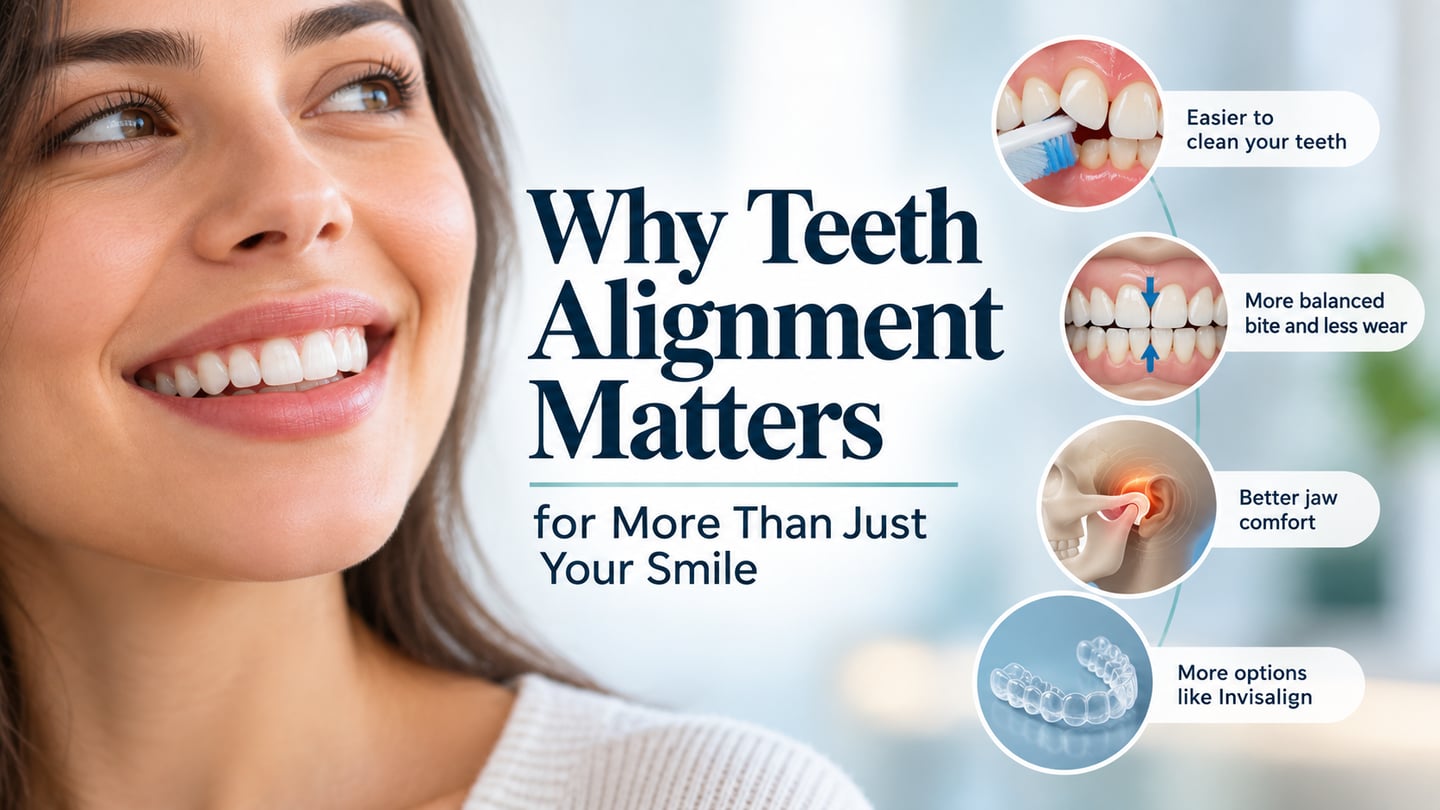
When people think about crooked or crowded teeth, the first thing that usually comes to mind is appearance. That's a fair association — alignment does affect how a smile looks — but it's only part of the picture. How your teeth fit together also affects how easily you can clean them, how evenly the forces of chewing get distributed, and how comfortable your jaw joint feels over time. This article looks at the functional side of alignment: not "should you get straighter teeth," but what alignment actually does for the rest of your oral health.
What "Alignment" Actually Means
Alignment refers to two related things: how individual teeth are positioned (crowded, spaced, rotated) and how the upper and lower teeth meet when you bite down, which dentists call occlusion, or bite. A misaligned bite can take several forms — an overbite, underbite, crossbite, or open bite are the common categories — and crowding or spacing can exist somewhat independently of those bite patterns.
It's worth saying clearly: mild-to-moderate alignment variation is extremely common, and not every case needs to be treated. The question worth asking isn't "is my alignment perfect" but "is my current alignment creating problems I can address," which is a more useful and less absolute framing.
Alignment and Your Ability to Clean Your Teeth
This is probably the most direct connection, and it's easy to underestimate. Crowded or overlapping teeth create tight spaces that are genuinely harder to reach with a toothbrush and floss, regardless of how careful or consistent someone's home care routine is. Plaque that would otherwise get brushed away in a more open area can sit in those tight overlaps, which raises the risk of both cavities and gum inflammation in those specific spots over time.
This is why two people with identical brushing habits can end up with different outcomes — alignment is one of the variables that affects how much protection a given amount of effort actually buys you. It's not a reason to feel discouraged if you have some crowding; it's more a reason to know where to focus extra attention (often between crowded teeth) and why your dentist might flag certain areas more than others during a cleaning.
Alignment and How Your Bite Distributes Force
When teeth meet evenly, the force of biting and chewing gets spread across a broad, stable surface. When the bite is uneven — for instance, if a few teeth are taking on more contact than they're built for — those teeth can experience more wear, chipping, or stress over time than they would in a more balanced bite. This is a slow, cumulative effect rather than something that causes sudden problems, which is part of why it's easy to overlook for years.
An uneven bite can also make certain teeth more prone to sensitivity or minor fractures over time, simply from bearing more than their share of the workload. None of this means an uneven bite is an emergency — it's more that alignment is one of the quieter factors influencing how your teeth age.
Alignment and Jaw Comfort
The jaw joint (the temporomandibular joint, or TMJ) and the surrounding muscles work together with your bite as a system. When the bite is significantly uneven, the jaw sometimes has to work harder or shift position to find a comfortable way to close, which can contribute to muscle tension over time for some people. This connection isn't universal — plenty of people with uneven bites have no jaw discomfort at all, and plenty of jaw discomfort has nothing to do with alignment — but it's a piece worth understanding if you experience jaw tightness, clicking, or soreness, since alignment is one of several things a dentist would consider when trying to understand what's going on.
Where Invisalign and Similar Approaches Fit In
Clear aligner treatment, like Invisalign, is one tool for gradually shifting teeth into a more even position, using a series of custom, removable trays rather than fixed metal brackets. It's not the only way to address alignment, and it isn't the right fit for every situation — more complex bite issues sometimes call for a different approach. What it does offer is a more discreet, removable option for people who want to address crowding or bite issues without traditional braces.
Whether clear aligners, another orthodontic approach, or simply closer monitoring is the right call really depends on what's actually going on with your particular bite and teeth. If you're curious what that would look like for your situation, our Invisalign page walks through how the process works, though the more useful first step is usually just having your bite evaluated so you know what you're actually working with.
How Alignment Actually Gets Evaluated
Alignment is assessed through a combination of a visual exam, checking how your teeth meet in different positions (biting normally, sliding side to side), and imaging that shows what's happening below the gumline, including root positions and jaw joint structure. This is a normal, non-invasive part of a routine exam — it doesn't require a special visit on its own, and it's often something your dentist is already glancing at during a regular cleaning, even if it isn't the main topic of conversation. If wear patterns, crowding, or bite issues stand out, that's usually when a more focused conversation about options happens, rather than treatment being suggested out of nowhere.
A Note for Parents
Alignment is also something dentists keep an eye on during childhood, since jaw growth is still happening and some issues are easier to guide early than to correct later. This doesn't mean every child with some crowding needs early treatment — many kids' bites settle into a workable position as their permanent teeth come in and their jaws finish growing. It just means that alignment monitoring is a normal, ongoing part of pediatric dental visits, not something that suddenly becomes relevant at a certain age. If you're curious what's being tracked at your child's checkups, it's a completely reasonable thing to ask about directly.
Signs Worth Paying Attention To
None of these are cause for alarm on their own, but they're reasonable things to mention at your next visit if you notice them:
- Certain teeth consistently trapping food or being harder to floss than others
- Visible flattening or chipping on the edges of specific teeth
- Jaw soreness, tightness, or a clicking sound when you open and close your mouth
- Gum inflammation that seems concentrated around a few crowded teeth rather than spread evenly
Any one of these can have causes unrelated to alignment too, which is exactly why an actual evaluation is more useful than trying to self-diagnose from a list like this one.
It's Not About Perfection
It's worth repeating: the goal here isn't presenting "straight teeth" as some universal requirement. Plenty of people have minor alignment variation their whole lives with no issues at all. The point of understanding this connection is just to give you a fuller picture of what alignment does functionally, so that if you are noticing wear, cleaning difficulty, or jaw discomfort, you have a better sense of one of the possible contributing factors — and so a conversation about alignment doesn't feel purely cosmetic if it comes up.
Frequently Asked Questions
Does crooked teeth always mean I need orthodontic treatment? No. Mild misalignment is common and doesn't automatically require treatment. It becomes more relevant to address when it's creating specific issues — difficulty cleaning certain areas, uneven wear, or bite-related discomfort.
Can alignment issues cause cavities by themselves? Not directly — cavities are caused by bacteria and plaque. What alignment does is make certain areas harder to clean effectively, which can raise the risk in those specific spots. Good technique and tools like floss picks or water flossers can help offset some of that added difficulty.
Is jaw pain always related to bite alignment? No — jaw pain and TMJ-related discomfort can come from several sources, including teeth grinding, stress, or joint issues unrelated to alignment. Alignment is one factor a dentist would consider, not an automatic explanation.
How do I know if Invisalign or another option is right for me? That depends on the specifics of your bite and teeth positioning, which really does require an in-person evaluation. Some cases are well-suited to clear aligners, while more complex bite issues may call for a different approach or a referral to an orthodontic specialist.
At what age should alignment issues be evaluated? Alignment can be relevant at any age — some issues are easier to address earlier, but plenty of adults address alignment successfully as well. There isn't a strict cutoff; it's more about evaluating what's going on currently.
A Fuller Picture, Not a Sales Pitch
The goal of this article is simply to explain the "why" behind alignment — not to suggest everyone needs treatment. If something here sounds familiar (food trapping in the same spot, a jaw that feels tight, edges that seem more worn on one side), it's a reasonable thing to mention at your next cleaning. You're welcome to reach out through our contact page with questions, or request an appointment if you'd like your bite properly evaluated.