
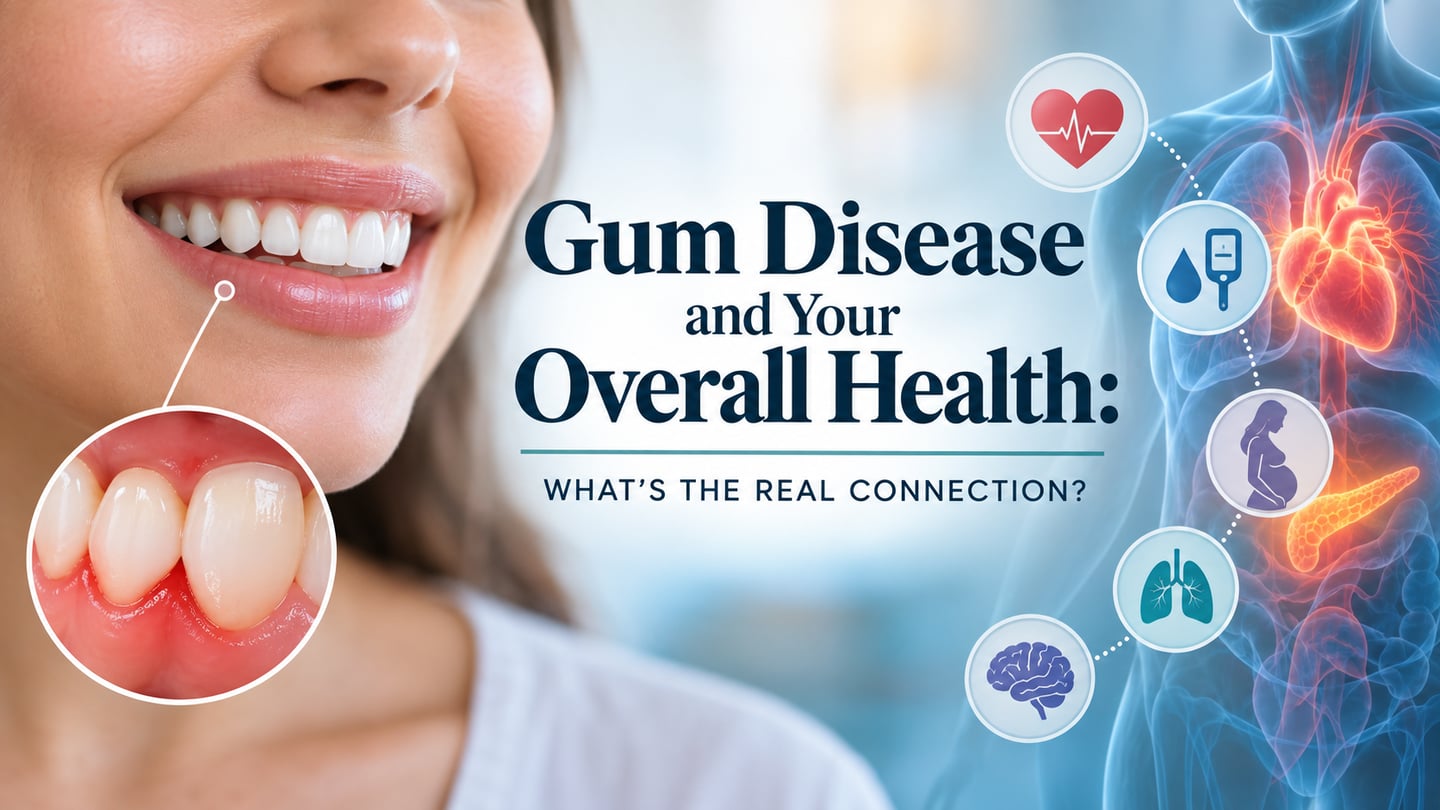
Gum disease is often talked about as a dental problem, and it is one — but it doesn't stay contained to your mouth. Researchers have spent decades studying links between gum disease and conditions elsewhere in the body, including heart disease, diabetes, pregnancy complications, and — in more recent research — cognitive conditions like Alzheimer's and other forms of dementia. This article walks through what those connections actually look like, what's well-established versus still being studied, and what it means for how you think about your gum health day to day.
What Gum Disease Actually Is
"Gum disease" covers a spectrum, starting with gingivitis — inflammation of the gum tissue, usually caused by a buildup of plaque bacteria along the gumline. At this stage, it's typically reversible with good cleaning and professional care. Left untreated, gingivitis can progress to periodontitis, a more advanced form where the inflammation begins to break down the bone and connective tissue that hold teeth in place. Periodontitis isn't reversible in the same way — treatment at that stage is about managing and stabilizing the condition rather than undoing the damage already done.
The common early signs — gums that bleed when you brush or floss, redness, puffiness, or persistent bad breath — are worth paying attention to precisely because they're often painless. Gum disease has a reputation for progressing quietly, which is part of why it's easy to underestimate.
Why Gum Inflammation Doesn't Necessarily Stay in Your Mouth
The mechanism researchers point to most often is fairly straightforward: gum disease is, at its core, a chronic inflammatory condition, and it involves populations of bacteria that can enter the bloodstream through inflamed gum tissue. Once in the bloodstream, that inflammation and bacterial activity can potentially interact with other systems in the body. This is the general biological basis for most of the associations described below — it's less about one specific chain of cause-and-effect and more about chronic oral inflammation being one contributing factor among several in various systemic conditions.
It's worth being precise about the word "associated." In most cases, the research shows a correlation — people with gum disease are statistically more likely to also have certain other conditions — rather than definitive proof that gum disease directly causes those conditions in every case. That distinction matters, and any dentist being straightforward with you should be honest about it rather than overstating the certainty.
Heart Disease
This is probably the most studied of the systemic connections. A 2025 scientific statement from the American Heart Association concluded that periodontal disease is associated with a higher risk of atherosclerotic cardiovascular disease (ASCVD) through shared chronic inflammatory pathways — but the statement is careful to say that "a cause-and-effect relationship has not been confirmed," and that there's currently no direct evidence that treating gum disease itself prevents cardiovascular disease. In other words, the association is well documented; proof that fixing one directly protects the other is not yet there, and the AHA has specifically called for more long-term studies and clinical trials to settle that question. Practically speaking, it's still one more reason gum health is worth taking seriously if you already have cardiovascular risk factors in your family or medical history — just not a guarantee that gum treatment alone changes your heart disease risk.
Diabetes: A Two-Way Relationship
The connection between gum disease and diabetes is one of the more well-established ones, and it's notable because it appears to run in both directions. Poorly controlled blood sugar can make a person more susceptible to infections, including gum infections, and more prone to more severe gum disease. At the same time, the chronic inflammation caused by gum disease can make it harder to control blood sugar levels, potentially complicating diabetes management. Because of this two-way relationship, many physicians and dentists now treat gum health as a genuinely relevant piece of diabetes care, not a separate issue running in parallel.
Pregnancy
Hormonal changes during pregnancy can make gum tissue more sensitive and prone to inflammation, a common condition sometimes called "pregnancy gingivitis." Separately, some earlier observational studies found an association between maternal periodontal disease and outcomes like preterm birth or low birth weight. However, larger randomized controlled trials since then — including a National Institutes of Health-funded study of more than 800 pregnant women — found that treating periodontal disease during pregnancy did not reduce the rate of preterm birth or low birth weight. So while the earlier association drew a lot of attention, the more rigorous follow-up research hasn't shown that treating gum disease specifically prevents those outcomes. Regardless, pregnancy is still generally a good time to keep up with routine dental care, since hormonal changes alone are reason enough to pay closer attention to gum health during those months.
Cognitive Health: Alzheimer's and Dementia
This is one of the more actively researched connections in recent years, and it's understandably a topic that gets people's attention. Several studies have found that people with a history of chronic periodontitis appear to have a higher likelihood of cognitive decline or a dementia diagnosis later in life compared to people with healthier gums, and some research has looked specifically at a possible role for oral bacteria in Alzheimer's disease.
The most-cited piece of this research is a 2019 study, published in the journal Science Advances, that identified Porphyromonas gingivalis — one of the main bacteria associated with periodontitis — along with its toxic byproducts (enzymes called gingipains) in the brain tissue, spinal fluid, and saliva of Alzheimer's patients. The researchers found gingipains in 96% of the brain samples they examined, with higher concentrations in samples showing more advanced Alzheimer's pathology. The proposed mechanism is similar in spirit to the heart disease connection: chronic gum inflammation may allow bacteria or inflammatory byproducts to travel beyond the mouth — through the bloodstream, and possibly along nerve pathways connecting the mouth and brain — and contribute, over time, to the kind of chronic neuroinflammation that's been observed in Alzheimer's disease. Other studies have taken a broader population-health approach, tracking large groups of people over many years and finding that those with more severe or longer-standing gum disease tend to show a somewhat faster rate of cognitive decline.
It's important to be precise about what this research does and doesn't show. Even the authors of the 2019 study described their findings as evidence for a possible role, not proof of causation, and the American Academy of Periodontology's own coverage of the research quotes one of its co-authors saying "additional research is needed to better understand" how the two are connected. It does not show that gum disease causes Alzheimer's disease, and Alzheimer's and other forms of dementia have multiple known and suspected contributing factors, of which oral health is, at most, one. A follow-up clinical trial has since tested whether blocking these bacterial enzymes with medication might help slow Alzheimer's progression — the kind of study that's specifically designed to move a hypothesis like this from "associated" toward "understood," and it's still the subject of ongoing research rather than a settled conclusion. As with the other connections in this article, it's a reason to take gum health seriously as part of your overall health, not a reason for alarm about a specific individual outcome.
Respiratory Health and Other Areas of Ongoing Research
Some studies have also looked at potential links between oral bacteria and respiratory conditions, since bacteria from the mouth can, in some circumstances, be aspirated into the lungs. This is a newer and less settled area of research compared to the cardiovascular and diabetes connections. Researchers continue to explore possible links to other conditions as well, including rheumatoid arthritis. As with the cognitive health research above, these areas are worth knowing about, but the evidence is still developing, and it's reasonable to hold them a bit more loosely than the better-established heart disease and diabetes connections.
Who Tends to Be More at Risk
Gum disease risk isn't evenly distributed — some factors make it more likely regardless of how consistent someone's home care is. Smoking is one of the strongest risk factors, both because it reduces blood flow to the gums (which can mask early bleeding, one of the main warning signs) and because it slows healing. Genetics also plays a meaningful role — some people are simply more prone to gum inflammation even with good hygiene, which is why family history is worth mentioning to your dental team. Hormonal shifts, including puberty, pregnancy, and menopause, can temporarily increase gum sensitivity. Certain medications, particularly ones that cause dry mouth, can also raise risk, since saliva plays a natural role in controlling bacteria. None of these factors make gum disease inevitable, but they do mean two people with similar brushing habits can end up on different paths, which is exactly why regular professional evaluation matters alongside daily care at home.
What This Means Day to Day
None of this is meant to suggest that gum disease single-handedly causes serious illness, or that perfect oral hygiene guarantees protection from these conditions — health is influenced by many overlapping factors, and oral health is simply one piece of that picture. What it does mean is that gum health is reasonably viewed as part of your overall health picture, not a separate category entirely. A few practical takeaways:
- Bleeding gums are common, but they're not "normal" in the sense of being harmless — they're usually a sign of inflammation worth addressing.
- If you have a family history of heart disease, diabetes, or dementia, or you're managing any of these currently, it's worth mentioning that to your dental team, since it can inform how closely your gum health should be monitored.
- Routine cleanings matter more than they might seem to, particularly because early gum disease is often symptom-free.
- Conversely, if you're working with a physician on a condition like diabetes or heart disease, it's worth letting them know if you also have a history of gum disease — that context can be useful on their end too.
You can read more about how we evaluate and manage gum health, from early gingivitis through more advanced periodontal care, on our periodontal care page.
Frequently Asked Questions
Can gum disease actually cause a heart attack? The research shows an association between gum disease and cardiovascular disease risk, largely through shared inflammatory pathways, but it hasn't been proven as a direct, singular cause. It's one contributing factor among several, not a stand-alone trigger.
If I have diabetes, does that mean I'll definitely get gum disease? No — but diabetes, especially when blood sugar isn't well controlled, does increase susceptibility to gum infections and can make existing gum disease more severe. It's a risk factor worth being aware of, not a certainty.
Is gingivitis the same as periodontitis? No. Gingivitis is the earlier, milder stage — inflammation of the gum tissue that's generally reversible with good care. Periodontitis is more advanced and involves loss of the bone and tissue supporting the teeth, which isn't reversible in the same way, though it can be managed and stabilized.
Are bleeding gums always a sign of gum disease? Bleeding is one of the most common early signs, though occasional minor bleeding (from brushing too hard, for instance) isn't automatically a diagnosis. Persistent or frequent bleeding is worth having evaluated rather than assumed away.
Can improving my gum health actually help other health conditions? Some studies suggest that treating gum disease can modestly improve markers like blood sugar control in people with diabetes, though it isn't a substitute for medical treatment of those conditions. It's best thought of as one supportive piece of a broader health picture, managed alongside your physician.
Does gum disease cause Alzheimer's or dementia? No — the research shows a statistical association and a plausible biological pathway (including specific bacteria found in the brain tissue of some Alzheimer's patients), not proof of direct causation. Dementia has multiple known and suspected contributing factors, and oral health is, at most, one piece of a much larger picture. It's an active area of ongoing research rather than a settled conclusion.
A Two-Way Conversation
If it's been a while since your gum health was evaluated, or if you have a family or personal history of heart disease, diabetes, or another condition mentioned here, it's a reasonable thing to bring up at your next visit — and honestly, we'd rather you ask than wonder. You can reach out through our contact page with questions, or schedule a visit if it's been a while since your last checkup.