
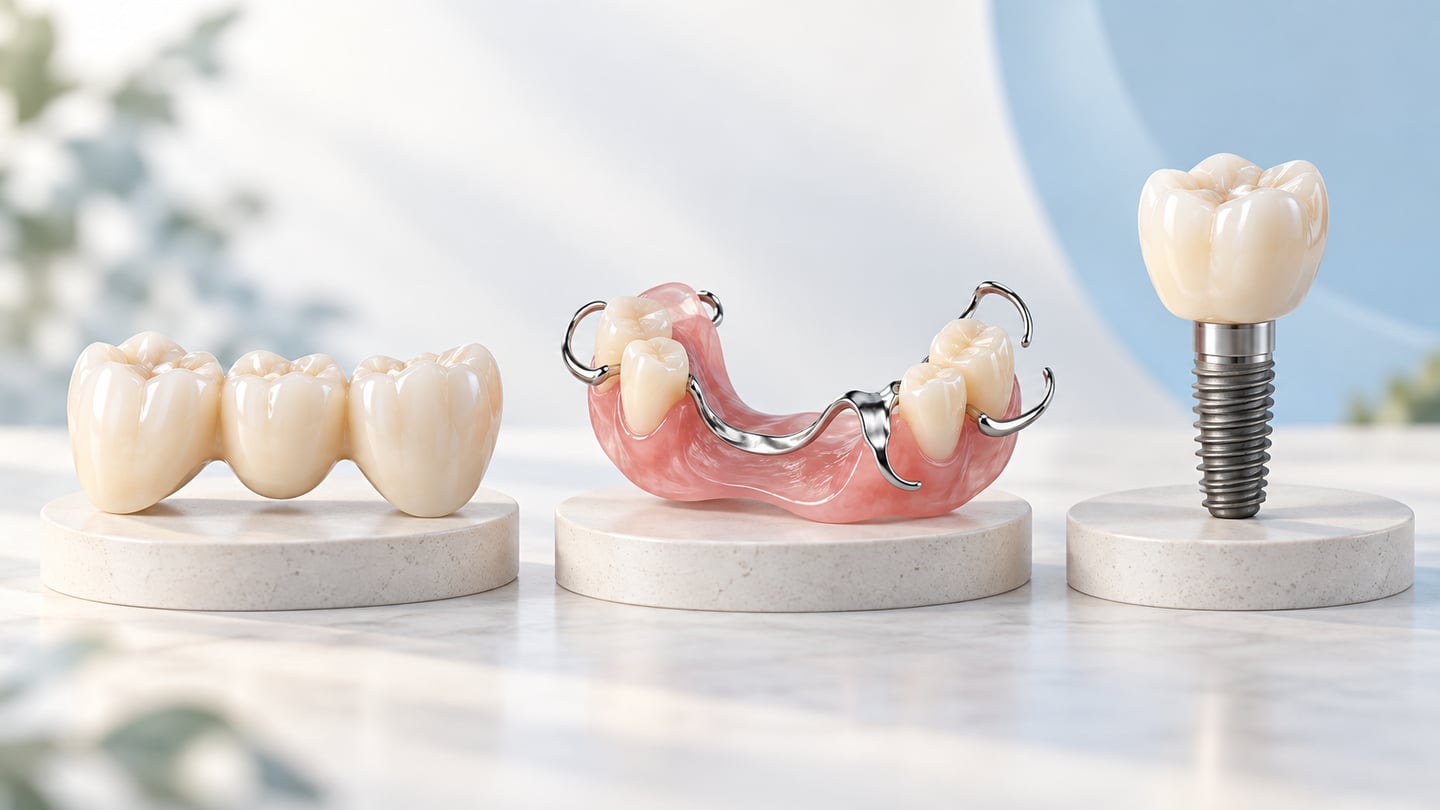
If you're missing a tooth — whether from an injury, decay, or a procedure like an extraction — you have more than one reasonable way to address it, and no single option is automatically "right." The three most common approaches are a fixed dental bridge, a removable denture or partial denture, and an implant-supported crown. Each works differently, fits different situations, and comes with its own set of trade-offs. This guide walks through how each one works and what tends to make it a better or worse fit, so that when you do sit down with your dentist, you're asking the right questions instead of starting from zero.
Why Replacing a Missing Tooth Is Worth Thinking About
It's easy to assume that a missing back tooth, in particular, isn't a big deal — nobody sees it, and chewing still mostly works. In practice, though, teeth don't exist in isolation. Each tooth helps hold its neighbors in place and gives your bite a stable, even structure to work against.
When a tooth is missing for a while, a few things tend to happen gradually rather than all at once. Neighboring teeth can drift or tilt into the open space, since they're no longer held in position on both sides. The tooth in the opposite jaw — the one that used to bite against the missing tooth — can slowly over-erupt, moving further out of the gumline because there's nothing to stop it. And the jawbone underneath the gap, which needs the pressure of chewing to stay dense, can begin to lose volume over time, a process called bone resorption.
None of this happens overnight, and plenty of people go years without major issues. But it's useful to understand these effects exist, because they're the reason "replace it eventually" and "replace it now" aren't always equivalent choices — the situation your dentist is working with can shift over time.
Option 1: Fixed Dental Bridges
A dental bridge replaces one or more missing teeth by anchoring a replacement tooth (or teeth) to the natural teeth on either side of the gap. Those anchor teeth are shaped and capped with crowns, and the replacement tooth sits between them, fused into a single connected piece. Once placed, a bridge isn't removed for cleaning — it functions like a fixed part of your mouth, cleaned in place the same way your other teeth are, with some extra attention to the area underneath the replacement tooth.
Bridges tend to be a good fit when the teeth on either side of the gap are already strong and healthy enough to support crowns, and when someone would prefer a fixed, non-removable solution over something they take in and out. Because it relies on the neighboring teeth for support, a bridge does involve reshaping those teeth to accept crowns — which is a meaningful, permanent step worth understanding fully before moving forward. You can read more about how the process works on our dental bridge page.
Option 2: Removable Dentures and Partial Dentures
Dentures replace missing teeth with a removable appliance rather than something fixed in place. A full denture replaces all the teeth in an arch (upper or lower), while a partial denture fills in gaps where some natural teeth remain, using clasps or attachments to stay secured to the surrounding teeth.
Modern dentures and partials have come a long way in fit and comfort compared to older versions many people remember from family members. They're often a good option when several teeth are missing, when someone prefers not to have additional procedures done on their remaining natural teeth, or when cost and treatment timeline are important considerations. They do require a bit of an adjustment period, and most people find they need to reline or adjust them periodically as the mouth naturally changes shape over time. More detail on what to expect is on our dentures and partial dentures page.
Option 3: Implant-Supported Crowns
An implant-supported replacement uses a small titanium post placed into the jawbone, which fuses with the bone over a period of months and then supports a custom crown on top. Unlike a bridge, it doesn't rely on the neighboring teeth for support, and unlike a denture, it isn't removable — it functions much like a natural tooth root.
This approach is often appealing to people who want a solution that most closely mimics a natural tooth, both in function and in how it feels day to day. It also has the advantage of stimulating the jawbone in the same way a natural tooth root does, which can help preserve bone density in that area — something bridges and dentures don't do in the same way. The trade-off is that it typically involves a longer overall timeline, since the implant needs time to integrate with the bone before the crown is placed, and it depends on having adequate bone and gum health to begin with. You can see how the final crown restoration works on our porcelain crowns page.
So How Do You Actually Decide?
There isn't a universal "best" option — the right fit depends on things like how many teeth are missing, the health of the surrounding teeth and bone, your overall health history, your timeline, and your own preferences about fixed versus removable solutions. A few questions worth bringing to your next visit:
- What does the bone and gum tissue around the gap actually look like right now?
- Are the neighboring teeth healthy enough to support a bridge, or would that mean treating teeth that are otherwise fine?
- How much time realistically works for me — am I looking to resolve this quickly, or is a longer process okay?
- What does the maintenance look like for each option, long term?
A thorough exam — including imaging to see what's happening beneath the gumline — is really the only way to answer these accurately for your specific situation. If it's been a while since your gap was evaluated, that's a reasonable first step regardless of which direction you're leaning.
What If You Just... Wait?
Sometimes waiting is a perfectly reasonable choice — for instance, if a decision needs more time, or a procedure needs to be scheduled around other priorities. It's just worth doing so with clear eyes rather than by default. The shifting and bone changes described earlier tend to make treatment more complex (and sometimes more involved) the longer a gap is left untreated, simply because there's more movement and less bone to work with. If you do decide to wait, it's worth asking your dentist what, specifically, to keep an eye on in the meantime.
Frequently Asked Questions
Is it really necessary to replace a missing back tooth if I can't see it? Not always urgent, but worth understanding the trade-offs. Back teeth do most of the heavy work in chewing, and their neighbors and opposing teeth can still shift or over-erupt even though the gap itself isn't visible.
How do I know if I have enough bone for an implant-supported crown? This is determined through a clinical exam and imaging, since bone volume varies a lot from person to person and location to location in the mouth. It's a normal, non-invasive part of the evaluation process.
Are dentures uncomfortable? There's usually an adjustment period, but a well-fitted denture shouldn't be a source of ongoing pain. If discomfort persists beyond the initial adjustment window, that's typically a sign an adjustment or reline is needed, not something to just live with.
Can I switch options later if I start with one and change my mind? In many cases, yes — for example, someone might start with a partial denture and move to an implant-supported option later. It depends on individual circumstances, so it's a good question to ask directly.
Does insurance typically cover tooth replacement? Coverage varies significantly by plan and by which option you choose. It's worth checking your specific benefits, and our front desk team is happy to help you understand what your plan covers before you commit to a direction.
Talk It Through With Someone Who Knows Your Mouth
The honest answer to "which option is best for me" almost always requires an actual look at your specific situation — your bone, your bite, your health history, and what matters most to you day to day. If you'd like to talk through your options in more detail, you can reach our team through our contact page or go ahead and request an appointment whenever it's convenient for you. There's no pressure to decide on the spot — the goal of that first conversation is simply to give you clear, specific information about what your options actually look like.